Thursday, 14 May 2015

Friday, 18 July 2014
Analysing Photography

The advertisement above is for a professional photographer by the name of Dom Bower, and his company, Dom Bower Photography. The first thing that catches the eye of the viewer is the shadowed figure, perhaps done to show the person in the image has no identity until you enter their place; a shape without purpose. It gives the impression he does not work for any specific type of persons, and anyone can therefore hire his use.
The blank surroundings also give the impression that he will work to your specifications; you fill in the blank space in your requirements and he will make it happen - countryside, city, studio, low light, bright light; he will make it happen for you. The clear text means it is easy for someone to find him and get more information.
In summary, the poster captures your interest - makes you wonder what he is capable of, and thus want to visit his website and find out more.
Evaluation (Visual Language Of Photography)
The intention of this assignment was for me to show the uniqueness of this particular group of people in the world; how their costumes and collections define them as individuals.

This particular image, for example, is a very simple modification in Photoshop. However, it is meant to portray the splash of colour people like the subject, James "Yusei" Gaffney, add to what could otherwise be seen as a dull, uninteresting world. Deliberately positioned in the centre of the road to show how everything going past on either side is very much the same, whilst out in the open, where everyone can see him, is this bright, vibrant individual who stands out from his surroundings.
The results of the survey further support my intended meaning, showing, as they do, that James is not the only person who partakes in these activities, nor is the only one who wears costumes outside of conventions where this practice is almost obligatory! The cult is growing in popularity, particularly with the younger generation I have noticed, and the money that is spent by individuals to recreate their chosen characters is slowly increasing.
The results of the survey further support my intended meaning, showing, as they do, that James is not the only person who partakes in these activities, nor is the only one who wears costumes outside of conventions where this practice is almost obligatory! The cult is growing in popularity, particularly with the younger generation I have noticed, and the money that is spent by individuals to recreate their chosen characters is slowly increasing.
Wednesday, 16 July 2014
Bibliography
http://en.wikipedia.org/wiki/Cosplay
Wikipedia, Cosplay, 2014, Multiple Authors
http://yeinjee.com/tag/nobuyuki-nov-takahashi/
'Origin Of The Word Cosplay', Yeinjee Asain Blog, 2008, Nobuyuki Takahashi
http://ifanboy.com/articles/what-is-cosplay-and-why-do-people-do-it/
'What IS Cosplay and Why Do People Do It?', iFanboy, 2012, Molly McIsaac
Wikipedia, Cosplay, 2014, Multiple Authors
http://yeinjee.com/tag/nobuyuki-nov-takahashi/
'Origin Of The Word Cosplay', Yeinjee Asain Blog, 2008, Nobuyuki Takahashi
http://ifanboy.com/articles/what-is-cosplay-and-why-do-people-do-it/
'What IS Cosplay and Why Do People Do It?', iFanboy, 2012, Molly McIsaac
Monday, 14 July 2014
Evaluation (Research Techniques)
The research has been a tricky project.
I knew what I wanted to find out, however, phrasing the questions - or indeed finding the right questions without making people uncomfortable - was extremely problematic. As a result, I do feel I compromised on the questions a little too much, and thus did not find out exactly what I had intended to by asking them.
That said, the results I did achieve helped just as much with the project as the exact figures I would have liked could have.
I would like to have conducted some in-person interviews, which may have allowed me to extract more detailed information from interviewees about why they engage in this way of life, as well as potentially providing some additional photographic subjects. (N.B. I did have 2 other subjects lined up, however both mine and their schedules prevented us from meeting and carrying out the shoot.)
The choice of using a survey to record information was definitely a strong decision; within the first day it had 10 responses (the total number came in at 24 after 3 weeks live,) so it shows how fast it can be distributed.
Unfortunately, as previously mentioned, this was let down by questions that were not so strong.
Perhaps my second strongest decision was choosing to send the survey first two two individuals who knew multiple cosplayers and were part of a forum for those who partake in the activity, which is where most of the responses that followed originated from. This allowed me to get information from a range of individuals, as opposed to just those I knew and were basing my assumptions off of.
The results I achieved were not exactly as I had wanted, as mentioned earlier on, which is a result of the poor questions asked. However, I was able to make use of the data I recorded. As I didn't have exact figures, I worked off of the approximates that I received, which meant I could still continue with the project as planned.
If I were to continue this research in the future, I would like to find out how a cosplayer decides who they want to cosplay; what factors influence their choices and how they set about obtaining the correct materials to create their costume. I would also press for more exact figures when it came to expenditure.
I knew what I wanted to find out, however, phrasing the questions - or indeed finding the right questions without making people uncomfortable - was extremely problematic. As a result, I do feel I compromised on the questions a little too much, and thus did not find out exactly what I had intended to by asking them.
That said, the results I did achieve helped just as much with the project as the exact figures I would have liked could have.
I would like to have conducted some in-person interviews, which may have allowed me to extract more detailed information from interviewees about why they engage in this way of life, as well as potentially providing some additional photographic subjects. (N.B. I did have 2 other subjects lined up, however both mine and their schedules prevented us from meeting and carrying out the shoot.)
The choice of using a survey to record information was definitely a strong decision; within the first day it had 10 responses (the total number came in at 24 after 3 weeks live,) so it shows how fast it can be distributed.
Unfortunately, as previously mentioned, this was let down by questions that were not so strong.
Perhaps my second strongest decision was choosing to send the survey first two two individuals who knew multiple cosplayers and were part of a forum for those who partake in the activity, which is where most of the responses that followed originated from. This allowed me to get information from a range of individuals, as opposed to just those I knew and were basing my assumptions off of.
The results I achieved were not exactly as I had wanted, as mentioned earlier on, which is a result of the poor questions asked. However, I was able to make use of the data I recorded. As I didn't have exact figures, I worked off of the approximates that I received, which meant I could still continue with the project as planned.
If I were to continue this research in the future, I would like to find out how a cosplayer decides who they want to cosplay; what factors influence their choices and how they set about obtaining the correct materials to create their costume. I would also press for more exact figures when it came to expenditure.
Legal & Ethical (Research Techniques)
I approached my photographic subject and asked if he were happy to be pictured for this project. I stressed he was under no obligation to do so and if he accepted, could approve the images for use before I posted them.
With my survey, all those I sent the link to were told they did not have to answer it if they didn't feel comfortable doing so, as some questions could not be skipped due to data I needed to collect from them. For open questions, I never requested information they did not want to give, and allowed to write as much or as little as they were happy to do.
The entire project was designed to show off these interesting people in a positive light. As I mentioned above, my subject was allowed to approve photographs after they were taken, which ensured that only those showing him in the best way were used. He was given a digital copy of every image that was taken for his own records and personal use.
Thursday, 10 July 2014
Data Validity
The questionnaire I formulated contained a lot of open questions. Whilst I was able to find out, to some extent, the information I was hoping to, I did not find out precisely what I want. I am a stickler for exacts, so would have been happier receiving precise figures on what people spend for example.
However, the data I did record was helpful in its own way, as it gave me a rough idea the extent people will go to in obtaining the materials they need for their designs, as well as the large sums that they spend too, which is very close to what I was aiming to find out.
However, the data I did record was helpful in its own way, as it gave me a rough idea the extent people will go to in obtaining the materials they need for their designs, as well as the large sums that they spend too, which is very close to what I was aiming to find out.
Friday, 4 July 2014
L/601/8773 LO1 2.1 - Comparing Radio Adverts
The above is an advert for Alton Towers' recruitment drive in 2007. It has been recorded as in the style of a rider on one of the park's roller-coasters, with suiting sound effects and atmosphere included. The voiceover contains several interruptions meant to simulate the drops and twists on the ride, designed to catch the reader's curiosity and keep the reader listening to the end so as to hear the whole advert.
Within the first six seconds, the mood and location have been made clear - it is a 'fun' advert by the UK's leading theme park attraction, who are serious about having fun. Breaking the advertisement up with the roller-coaster 'drops' breaks up each individual point so that the audience, presumably university leavers and young adults (18-25 year olds) who are looking for work to start them off in life, can contemplate and assess each point before the final points are given at the end when the 'presenter' is 'off the ride.'
It is a light-hearted ad that seeks to remind us what sort of fun we have at theme parks such as Alton Towers, whilst ensuring we realise that there is a dedicated team behind it all who make everything happen. It is by all of this that they are trying to convince you that you should work for them, and that they want and will appreciate you being there.
This next advert is a radio commercial for the Toby Carvery restaurant chain.
In contrast to the Alton Towers advertisement, this is very much focused on what the advertisement says as opposed to how it is delivered, being very studio-sounding. It also utilises a range of voiceover artists, unlike Alton Towers' single artist. This method is probably to show that the carvery is for people from all walks of life - the aged, the young; anyone can enjoy a meal at this restaurant. There are some voices that cannot be heard as clearly as others, which make the edit feel a little ad-hoc, however the overall delivery is fairly clear and easy to understand.
Several lines have been included to show that it is a British Company. Not only are carveries a British Tradition (more commonly referred to as the 'Sunday Roast' in most households) but the chain use only British meat from British farmers, which is why they are 'the home of the roast.'
Friday, 20 June 2014
K/601/8327 -1.1, 2.1, 3.1, 3.2; Audience Research
Cosplaying has grown drastically as a pastime in recent
years.
Since the early 90s, Cosplay has gathered momentum in
popular culture, though the phrase ‘Cosplay’ was coined in 1983 in Japan. It is
a combination of two words, namely ‘costume’ and ‘play’ and is a hobby in which
the Cosplayer wears fashion and accessories to replicate the image of a
specific character from sources such as Manga, Anime, Comic Books and Video
Games. Most ‘Cosplayers’ will engage in some form of role-play, re-enacting
their idolised character’s persona and activities.
It is unclear as to when the practice originated, but to
dress up in costume related it has been in existence for numerous years. In
more recent years its following has increased substantially. For the first time
at an American convention, ticket sales have had to be capped due to the
ever-heightening numbers inside the convention halls. From experience, it could
well be not too long before we see the same occurring in the UK and at other
worldwide cons.
Manufacturers have, for some time, offered elements towards
full costumes for sale, such as replica swords, wigs and defining features, but
with this cult gaining more momentum by the day, more and more are offering full
costumes for sale in the states, and gradually more so in the UK. Many
individuals also custom-make their gear so as to accurately recreate what they
see on-screen (after all, not all commercially available inventory is 100%
accurate.) It is an activity spread widely across the demographics; from old,
retiring gentlemen to young wannabe princesses, from the poorest of the poor to
the richest of the rich, its appeal is unlimited.
But why does it appeal so greatly to so many?
What does ‘Cosplaying’ have to offer the ‘Cosplayer’?
I know several people that fall into this grouping, but have
never delved much deeper than asking what it is all about. To help my
understanding, I created an on-line survey, which I sent out to those I knew,
who then sent it on to those they knew, asking questions which, I hoped, would
answer some of my own questions, as well shedding light on the hobby to those
who are still none-the-wiser.
The link below links to the survey that I created and
circulated amongst the ‘Cosplayers.’
Some of my results have been shown in a previous post.
However, I was not expecting some of the results that I received.
I shall start by analysing the responses to question 2. I
know that some features, or entire ‘Cosplays,’ can cost well into hundreds of
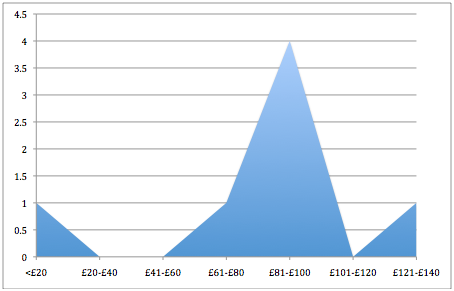
pounds, sometimes even thousands. It comes as quite a shock that only 2 of my
responders have spent more than £140, with the majority spending between £70
and £90 on their gear. It could be that these are ‘novices’ so to say, and
still finding their feet in the field, or indeed that they have come into the hobby
at a time when people are being more careful with money. However, given how
much may be required to build a full Cosplay, this is still a surprisingly low
amount.
Supporting my assumption that the Cosplay following here in
the UK is only just starting to grow, the majority of those who took my survey
responded to question 5 by answering that they purchase most of their Cosplays and
features not only from online sources, but import them from online non-UK
stores. This doesn't come as a surprise to me, as, to the best of my knowledge,
there are very few stores that supply even some features for Cosplays, the only
one I am consciously aware of being ‘Tokyo Toys’ in London’s Piccadilly Circus.
This could, perhaps, account for the few responses that selected the ‘buy in
store’ choice.
Whilst import seems to be the most used purchase method, there are almost as many who opt to hand-make their Cosplay, tailoring it to fit their exact body shape and including the features where and how they feel that they ought to be so.
Whilst import seems to be the most used purchase method, there are almost as many who opt to hand-make their Cosplay, tailoring it to fit their exact body shape and including the features where and how they feel that they ought to be so.
One query I wanted to answer was how often people wore their
Cosplays. I knew that it was common practice to wear them at conventions, but
were they worn at any other times?
44% of my respondents replied that they do only wear them at conventions, such as MCM and Hyper Japan. However, much to my interest, several people wore them once or twice a month, whilst one chose to wear theirs at least once a week. Perhaps my favourite response is that which reads ‘whenever I want to.’ It becomes clear that this is not just a thing done when en-mass, but continued in an individual’s own free time too.
My final question asked why
people who Cosplay do so. I had to leave this as an open questions, as there
were too many variables, but I was confident that there would be similar themes
in the answers. And indeed there were.
Through various words, the general consensus is that
Cosplaying allows you to be your ideal person. You can ‘embody characters that you otherwise wouldn't have the
opportunity to be,’ pretending to have ‘awesome powers’ and ‘mess with
the public’s heads.’
There
is a freedom that comes with Cosplaying that people wouldn't normally be able
to experience, because you can be who you want to be without any constraints; it
is a way of expressing your individuality. There is also a major social aspect
to it – the numbers that attend conventions and external meetings in their
costumes, it becomes one big family. It can well be said that the conventions
can feel almost party-like at times+, with music, dancing and socialising all
occurring.
Thursday, 19 June 2014
D/601/6672 – 1.1; Advertising

Gulf Lubrication Oil
For an advert, the above is very 'text-heavy,' with a lot of information included in the centre of the spread. However the visuals catch the eye - the vehicles seemingly speeding by so fast that they leave a trail of orange (like the logo) flames, which support the claims of the company that the oil is a 'supreme' product. The text, however, is very straight-forward and well structured, paragraphed and numbered by key point so that the more important information stands out.


Sticking with the theme of motor vehicles, the above is an advert the then-new 'Quality First' Morris car. In contrast to the lubricant oil advert, this advert is centered more around the image. The important text is in larger font and thus easily readable. The word Morris, at the base of the advert, is also in large font and also bold to emphasize the brand name, which was synonymous with the motor industry back in it's day. There is also a paragraph of small print; this is not readable on the PC screen but is likely to contain more information about the car and recommendations as to why it should be bought.
The slogan 'is a new and higher class of its own' is blatantly speaking to its target audience, those more well-off who could afford a luxury such as a motor car, and is supported by the accompanying background of what could be conceived as an estate, or perhaps a high-ranking university.
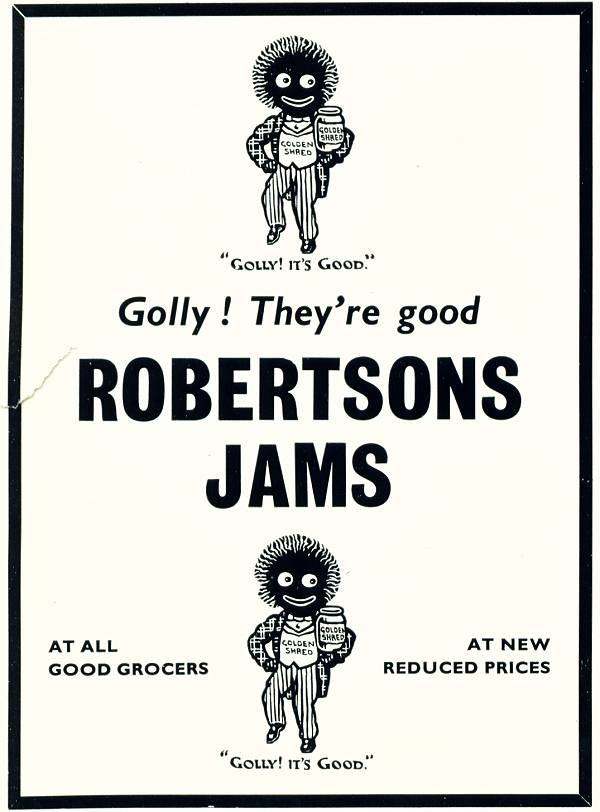
The 'Golliwog' on this advert instantly catches the audience's eye. Despite being around since 1873, the 1910 advertising campaign by Roberton's Jams was the first such use of the character in this form, having previously appeared in books and as rag dolls. The Golliwog was a popular creation which could be the reason why it was adopted as the mascot for the brand from then until 1988.
A simple ad, it plays one the name of the character, 'Golli-wog,' telling you how good the product is. It then emphasizes that the product is stocked only at 'all good grocers' at 'new reduced prices,' adding to the appeal of the product; it is cheap but high quality as only the good stores will stock it.

A more recent advert, this is for the charity Cancer Research UK. It plays on emotions of those who know or have experience the illness in some way and who would therefore understand how terrifying having cancer truly is. By evoking these feelings of fear in you, it aims to win you over with it's following lines 'One day we will beat cancer. Help us make it sooner.' Telling you that you can make cancer, something that is not a living being, afraid gives you the confidence that by donating to these people, you will make a difference, and that difference will be all the sooner because of your help.

A more recent advert, this is for the charity Cancer Research UK. It plays on emotions of those who know or have experience the illness in some way and who would therefore understand how terrifying having cancer truly is. By evoking these feelings of fear in you, it aims to win you over with it's following lines 'One day we will beat cancer. Help us make it sooner.' Telling you that you can make cancer, something that is not a living being, afraid gives you the confidence that by donating to these people, you will make a difference, and that difference will be all the sooner because of your help.
K/601/8327 -1.1; Research Plan
The purpose of my research is to explore the hobby, or in some cases lifestyle, of Cosplaying / Cosplayers. Ultimately, I want to find out why it is such a widely-enjoyed past-time; why do people choose to partake in the hobby, and how much can it affect their lives?
I know for a fact that Cosplays (the costume of a fictional character from a film, manga, anime or similar,) when of good quality, are not cheap to obtain either. Providing those I ask are willing to disclose such information, I also aim to find out the cost of some Cosplays, and what Cosplayers have spent on their entire costume, or even one individual item that forms part of it.
For this, I shall devise an online survey, with open and closed questions so as to get the answers I am after. For example, questions about cost or the reason that a Cosplayer Cosplays will be a text-box response, allowing them to give the answer they want to give. (I understand that amounts are normally a multiple-choice response, but given the varying cost of Cosplays and their associated features, this would require numerous options.)
Questions with multiple choice answers would be, for example, asking how many Cosplays an individual has (due to the high cost, most people own just one or two,) or what their main source of costume supply is.
I will also search online for similar information; the survey will likely only receive short responses. Many people who partake in this hobby also have Tumblr, Facebook and DeviantArt pages on which they share their photographs of their costumes, collections and their backstory relating to how they came about and joined the ever-growing movement.
For my photographs, I shall be using a Nikon D3100 with an 18-55mm lens.
K/601/8327 -3.1 + D/601/6672 – 3.1, 3.3; Infographics


These graphs were formed using data recorded from a survey I circulated to Cosplayers I know, which was then forwarded on to Cosplayers they knew. The survey can be accessed here:


Approximately how much do you spend on a Cosplay?


D/601/6672 – 3.1, 3.3; 'Workbook' Images


The above are a selection of images that were taken during my shoot with my subject, James "Yusei" Gaffney, and his extensive cosplay and anime-memorabillia collection.
In order, his cosplays seen are:
- Jack Frost (From 'Rise Of The Guardians')
- Kristoff (From 'Frozen')
- 'Gender-Bent' Rainbow Dash (From 'My Little Pony')
- Jesse Anderson (From 'Yu-Gi-Oh! GX')
- Pokemon Trainer (From 'Pokemon')
There are also pictures of some of James' extensive merchandise collection, which includes plushes, figurines, books and posters.
Subscribe to:
Posts (Atom)